
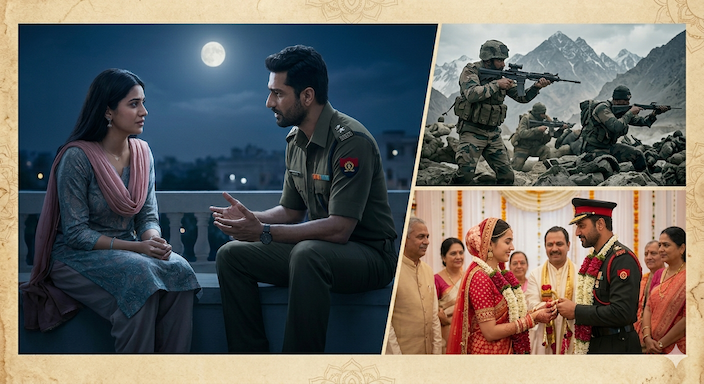
A Journey of Love and Valour
The sun shone gently over the ancient city of Bhopal, where Anaya, a tall, radiant young woman, stepped into the college auditorium with her leather sling bag bouncing lightly on her shoulder. Her black kohl-lined eyes scanned the class as she entered, adjusting her dupatta, exuding confidence and elegance. As an MBA student, Anaya had big dreams. She spoke often of marrying a man from an elite IT firm, a man who was well-read, diplomatic, and above all, believed in solving problems with peace, not conflict.
She would scoff when her friends talked about soldiers. “They glorify war,” she’d say. “We need Aman ki Asha, not guns and borders. Every problem can be solved over a table. Even India-Pakistan.”
Her views were about to be tested in ways she never imagined.
It was a humid evening in Gorakhpur when Anaya and her parents stepped off the train to attend a distant relative’s wedding. As they waited outside the railway station for a cab, a shouting match erupted between her father and an auto driver. Anaya tried to intervene, but the situation escalated as more drivers joined in. Fists flew. Her father, a mild-mannered man in his fifties, was pushed and punched. A crowd gathered, some jeering, others recording on phones. Nobody helped.
Then, like a scene from a movie, a man emerged from the shadows. Tall, broad-shouldered, his face darkened by the evening light, his uniform hidden beneath a casual shirt. His voice boomed, cutting through the chaos.
“Enough! Leave him!”
He moved like a storm—precise, controlled, deadly. Within minutes, the attackers scattered. He helped Anaya’s father to his feet, checked his pulse, and glanced at Anaya only once—his eyes sharp but soft. And just as suddenly, he disappeared into the crowd.
Anaya stood frozen. Who was he?
Hours later, at their relative’s house, Anaya walked into the drawing room—and gasped. There he was. Sipping tea calmly, now smiling. Her cousin introduced him.
“That’s Abhishek, my husband’s younger brother. Major Abhishek Bhardwaj. Indian Army.”
Her heart thudded. Indian Army?
Over the days, their paths crossed often. Anaya found herself drawn to him—his discipline, his subtle humor, the way he listened. He spoke rarely of his work, but once, on a moonlit terrace, he told her stories of border villages and how he’d held dying comrades in his arms.
“We don’t fight for war,” he said. “We fight so others can live in peace.”
He told her about children in border villages slaughtered in the middle of the night by infiltrators trained and armed across the Line of Control. Of a bus carrying pilgrims that was blown up just hours after his battalion passed that same route. Of villagers whose homes were bombarded by Pakistani shelling, their lives shattered without warning. Of intelligence intercepted proving how these attacks were orchestrated by handlers in Rawalpindi with tacit support from their military.
One evening, he described a raid where they rescued hostages held by jihadists—two teenage girls and a mother—chained and drugged. “They weren’t even human anymore,” he said, his voice cracking. “This is what we fight.”
Anaya listened, tears often spilling. Her heart shifted that night. Slowly, her disdain turned to respect. Respect deepened to love. They married within months, their union blessed by two happy families.
Life was blissful.
Until the mission.
One cold December night, Abhishek left for a covert operation near the Pakistan border. Days passed. Then a week. The army informed them: two soldiers missing. One body was found in the Ravi River. The other—Abhishek—was untraceable. Declared MIA: Missing in Action.
Anaya’s world collapsed. She screamed, cried, then sank into silence. Her in-laws held her through the nights. Her father-in-law, a retired colonel, never left her side.
Over months, grief hardened into purpose. Anaya changed. The former idealist now marched with tricolour in hand, speaking at forums, condemning sympathizers, calling for national strength.
“I was the bride of a soldier,” she’d say. “And now I’m the widow of a martyr.”
Two years passed.
She joined Hindu College as a Physics professor, honouring Abhishek’s wish for her to keep living, to keep teaching. Work kept her afloat. But the nights were still heavy.
Then came the evening that rewrote her destiny.
It was raining when she returned from college, umbrella in hand, anklets tinkling against the marble floor as she stepped into the drawing room—and saw him.
Sitting there.
Beard grown, hair long, eyes hollow but alive—Abhishek.
She dropped everything.
“Abhi…shek?”
He rose slowly. “Anaya.”
She ran to him, tears streaming, laughing and sobbing at once, hugging him like she would never let go.
He was back. Captured for two years. Tortured. Escaped.
But alive.
Their love, tested by war and silence, now had found its peace.
And Anaya, once a girl with fairy tale dreams, had lived through a tale far greater—one of love, loss, and the enduring strength of the human spirit.
—The End—
